Catalan Christianity; Benedictine Montserrat
Montserrat
Traditional date 880; first text dated 1239 · Montserrat, Catalonia · Traditional; Abbey of Montserrat

The Santa Cova, on the mountain below the monastery. The chapel over the cave was built between 1696 and 1705.
Source & rights
- What this is
- Material context
- Object
- Photograph
- Title
- The Santa Cova, Montserrat
- Creator
- Photographer identified on Commons as Bouddha5
- Date
- Photographed 2004; chapel built 1696–1705
- Licence
- Public domain
- This copy
- Hosted at the size published by the source; not altered.
- Retrieved
- 2026-08-29
An object of the same period and kind. Not a witness to this text and not a depiction of its events.
The place the tradition names, photographed some eleven hundred years after the date it gives. The chapel is a late-seventeenth-century building over a cave; it holds a reproduction of the image, the original being kept in the basilica above.
According to the tradition kept at Montserrat, shepherd children on the mountain saw a great light descend from the sky one Saturday in the year 880, and heard a beautiful melody with it. They came back the following Saturday with their parents, and the same thing was reported again. The rector of Olesa joined them for four further Saturdays.
A cave was eventually identified, and an image of Santa Maria found inside it. When the bishop tried to carry the image down to Manresa, the tradition says, it became so heavy that it could not be moved, and was understood to be refusing to leave the mountain.
The first text that refers to any of this is dated to 1239 - three and a half centuries after the year it describes, and the earliest point at which the story can be followed on paper at all.
The image is younger than the story

Source & rights
- What this is
- Material context
- Object
- Object
- Title
- La Mare de Déu de Montserrat, known as la Moreneta
- Creator
- Departament de Premsa i Comunicació de Montserrat
- Date
- Carving dated by the Abbey to the end of the 12th century
- Held by
- Abbey of Montserrat
- Licence
- Public domain
- This copy
- Hosted at the size published by the source; not altered.
- Retrieved
- 2026-08-29
An object of the same period and kind. Not a witness to this text and not a depiction of its events.
Filed as material context and not as a source object, because the record it appears on concerns an event dated to 880. Whatever else is true, this carving is some three hundred years younger than the discovery the tradition describes.
The traditional discovery is dated to 880. The sculpture venerated as the Moreneta is a Romanesque wooden carving which the Abbey itself dates to the end of the twelfth century. Those two statements cannot both be about the same piece of wood, and the Abbey has never asked anyone to think they are.
That does not settle the tradition, and it is not offered as a debunking. What it creates is a concrete problem about objects, of exactly the kind this project keeps running into elsewhere. Did an earlier image exist? Was one replaced by another, and if so, when, and did anyone record it? Did the identity of the shrine hold steady while the physical object changed underneath it?
There is a further turn at the cave itself. The chapel standing over the Santa Cova was built between 1696 and 1705, and the image inside it is a reproduction; the carving is kept in the basilica above. So the place where the object was found now holds a copy of a replacement.
At what point does the same image stop meaning the same matter and start meaning a lineage? The question is not rhetorical, and it is not confined to shrines. It is the same question this project has to answer about any old instrument that has been repaired, rebuilt, restrung and revarnished for three hundred years, and it does not have a clean answer there either.
What the source is
A foundation legend attached to a specific mountain, a specific cave and a specific object, maintained by the community that holds all three. The Abbey of Montserrat publishes it as tradition and states its own source date for it.
It is not a single text but a tradition with a textual history: a retable dated 1239 that no longer exists, a parchment codex described by early historians and since lost, an archive heavily destroyed in 1811, and a body of later retellings that diverge from one another.
What was reported in the sky?
Asked separately because the answer is narrower than the story usually gets. The traceable tradition describes light and music. It does not describe a solid aerial object, and this record does not supply one.
- Seen
- A great light, descending
- Heard
- A beautiful melody
- Time of day
- Dusk, in the usual telling; no hour is given
- Day
- Saturday, repeatedly
- Object described
- None. The sources describe light, not a thing
- First observers
- Shepherd children, unnamed
- Later observers
- Parents; the rector of Olesa; the bishop
- Contemporary record
- None known
The repeated Saturdays
As the Abbey sets them out. The repetition is not incidental to this tradition; it is the shape of it, and it is what brought adults, and then clergy, onto the mountain.
Saturday
Shepherd children on the mountain report a great light descending from the sky, with a beautiful melody.
The next Saturday
They return with their parents. The tradition says the same thing was seen and heard again.
Four further Saturdays
The rector of Olesa accompanies them, and the reports continue - six occasions in all, on the Abbey's telling.
Afterwards
The bishop is informed and comes to the mountain.
The cave
A cave is identified and an image of Santa Maria is found inside it.
The removal
An attempt to carry the image to Manresa fails: it is said to have become immovably heavy, and a shrine is built where it stopped.
What survives, and when
The distance between the first and second rows of this table is the whole difficulty with the record.
880
The traditional date of the events. No text from this century describes them.
1239
The date given for the first text referring to the legend - traditionally associated with a painted retable in the monastery's cloister. The retable is not extant.
Late 12th century
The Abbey's dating of the wooden carving now venerated as the image. It is therefore older than the first text and much younger than the event.
c. 1514 and after
Early Montserrat historians describe an old parchment codex of the legend held in the monastery archive. That codex is lost.
1811
The monastery is sacked and burned during the Peninsular War, and the archive suffers heavy destruction.
1696–1705
The present chapel is built over the cave. It holds a reproduction; the image itself is kept in the basilica.
1879
A popular English travel book prints a version of the legend which differs from the Abbey's in almost every particular.
The report
Original
In the year 880, some shepherds who had climbed the mountain in search of stray goats heard celestial harmonies among the rocks. This phenomenon coming to the ears of Bishop Gondemar, he climbed to the spot, and was led by the music to the mouth of a cave, which exhaled a delicious perfume. There, enshrined in light, lay the sacred statue.No English translation is published. None has been prepared and reviewed, and an unchecked rendering of the only text on this page would be the one thing this record cannot afford.
One phrase, closely
- Source
- There, enshrined in light, lay the sacred statue
- Literal
- the light is inside the cave, around the object
- Rendered as
- In the Abbey's account the light is in the sky, before anything is found
Set this beside the Abbey's version and almost nothing matches. Taylor has shepherds rather than children, no repetition and no Saturdays, no parents and no rector, and no light in the sky at all - the light is in the cave, around the statue, after the music has led the bishop to it. He also has the statue carved by St Luke and brought to Spain by St Peter, which the Abbey does not. Two accounts of the same tradition, both published in good faith, disagreeing about what was seen, who saw it, how often, and in what order. That is what a legend looks like from inside its own transmission.
Why it is in this archive
Because of the combination, which no other record in this collection has all of at once: a reported light in the sky, a reported sound, repeated observation on a known interval, a fixed place that still exists, the discovery of a physical object, unbroken pilgrimage to the site, and a surviving object whose age does not match the story.
The repetition is the part worth dwelling on. A single sighting by a child is a report. A phenomenon that is said to return on six consecutive Saturdays, drawing first parents and then a parish priest, is a claim of something closer to a schedule - and a schedule is the kind of claim that could in principle have been tested by anybody willing to climb the mountain on a Saturday. Whether anybody did, and what they found, is not recoverable.
The object is where the record becomes genuinely hard. The events are dated 880; the carving venerated as the image is dated by the Abbey itself to the end of the twelfth century. Those two statements cannot both be about the same piece of wood.
And the source date is not simple either. The Abbey gives 1239 for the first text. The retable that date is attached to is gone, the parchment codex the early historians cite is gone, and the archive that would have held the evidence was burned in 1811. Scholars have questioned the 1239 dating on linguistic grounds; this project has not read those studies and does not report a verdict on them. What can be said without reading anything is that the earliest surviving witness to a ninth-century event is, at best, a thirteenth-century one, and that the chain between them is broken in several identifiable places.
The words the source uses
Given in the language they were written in, with a plain rendering. None is treated as equivalent to a term from another tradition.
- una gran llum, acompanyada d'una bella melodia
- a great light, accompanied by a beautiful melody
- The Abbey's own wording for what was reported. It is worth holding on to, because it is more restrained than most of what is written about this episode: a light and a sound, with nothing said about a source for either.
- la Moreneta
- the little dark one
- The popular name for the image, from the darkness of the face and hands. The Abbey attributes the colour to the alteration of varnish over time rather than to the original carving.
- Santa Cova
- holy cave
- The place, which unlike the event has an address and can be visited. What stands there now is a chapel of 1696–1705, and the image inside it is a copy.
How close is the source?
Carried within a religious literary tradition, with the shaping that implies.
01 · Reported by
Shepherd children on the mountain, unnamed
No source names them, and this record does not.
02 · Repeated before
Their parents, and the rector of Olesa
03 · Investigated by
The bishop, in the tradition's own telling
04 · First written
A text traditionally dated 1239
Three and a half centuries after the events. Associated with a retable in the old cloister which is not extant.
05 · Described by
Early modern Montserrat historians, from an old parchment codex
The codex is lost. It is known only through what they said about it.
06 · Lost in
The destruction of the monastery and its archive, 1811
07 · Retold by
Nineteenth-century travel writers, among many others
Bayard Taylor's version, quoted on this page, is one of these and does not agree with the Abbey's.
08 · Published today by
The Abbey of Montserrat, on its own website
Used here as a research source and quoted only in short, attributed phrases. Nothing from the Abbey's site is mirrored.
Source gallery
Every image is labelled with what it is evidence for. Select one to see it whole.
Project Nikolaos annotation
Written by this project. Not part of the source, and not a translation of anything in it.
The statue is three hundred years younger than the story about how it was found. That is not a scandal and it is not a refutation. It is a question about what a shrine keeps continuous - the matter, or the place, or the practice - and I do not think the tradition has ever claimed it was the matter.
Details, provenance and rights
- Experiencer state
- Awake
- Reported agency
- Unidentified agency
- Locomotion claim
- Descent
- Physical trace
- Material trace reported · Unresolved
- Witness or speaker
- Shepherd children, unnamed; later their parents and the rector of Olesa
- Recorder / translator
- Unknown. The tradition reaches the present through medieval and early modern texts, and through the Abbey's own account of them.
- Edition
- Abbey of Montserrat, published account of the tradition (Catalan); Bayard Taylor, By-ways of Europe, 1879, p. 167
- Rights
- Rights not yet verified
- Cultural sensitivity
- Context needed
Provenance notes
- This project has not examined the 1239 text, any medieval manuscript of the legend, or the image itself. Everything here rests on the Abbey's published account and on printed later sources.
- The Abbey's account is quoted only in short attributed phrases and is not reproduced. Its photographs are not used; the image of the Moreneta on this page is a separate public-domain file released by the Abbey's press department.
- Scholarly objections to the 1239 dating are referred to but not adjudicated. This project has not read the philological literature, and states the objection as an objection rather than as a finding.
- The date 880 is the tradition's own. Naming it does not establish that anything happened in that year.
- The photographs of the Santa Cova show a chapel of 1696–1705 over the cave. No image on this page depicts the reported events, and none is offered as though it did.
The images on this page are public domain and self-hosted, with each licence verified against its source record. The Abbey of Montserrat's website is used as a research source and linked, not mirrored: its text and photographs are its own. The 1879 Taylor pages are out of copyright.
Read next to this
Chosen for what they can be compared on. The comparison is between the records, not between the things reported.
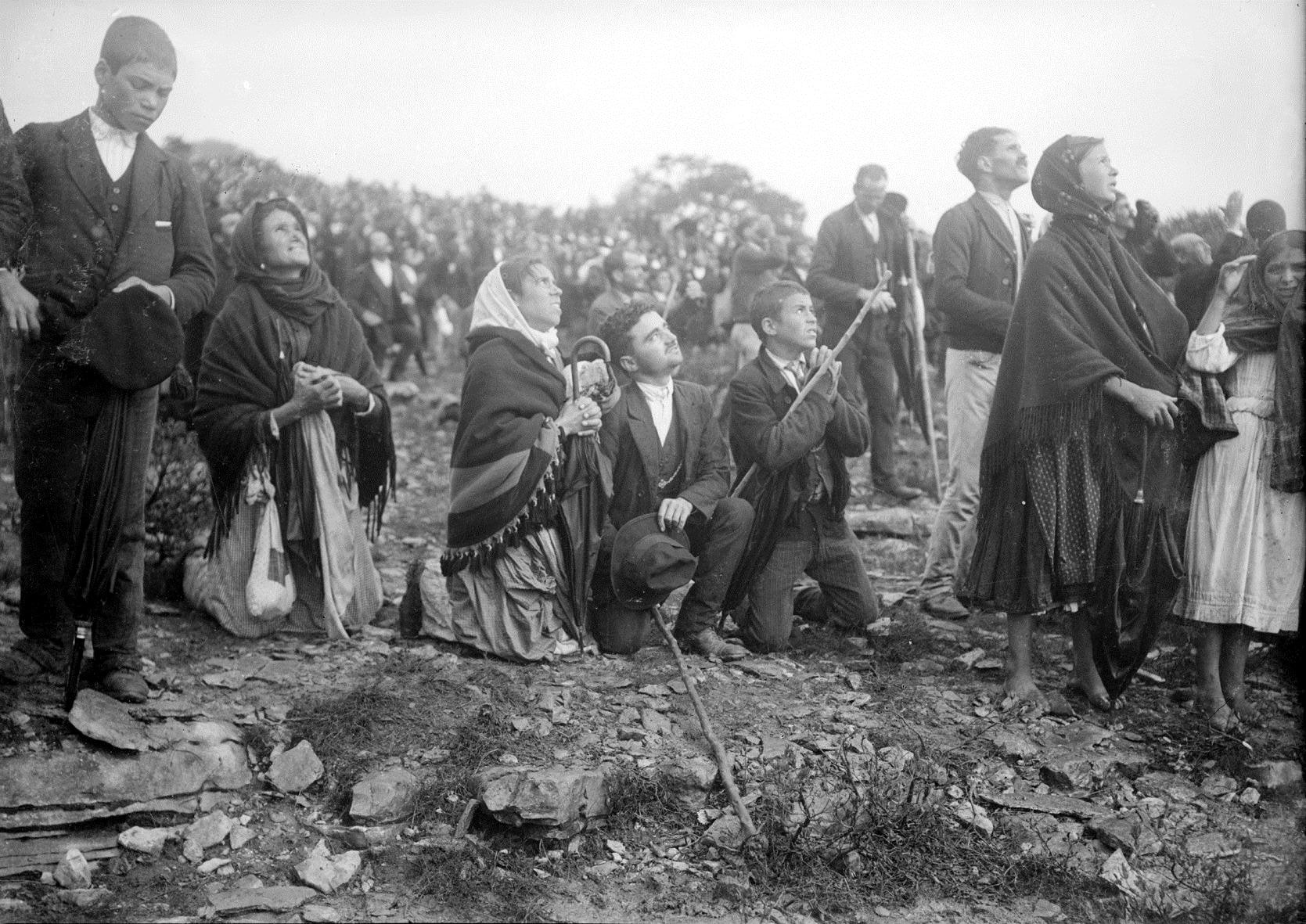
Fátima
May–October 1917 · Cova da Iria, Fátima, Portugal
Three children report repeated apparitions. A crowd gathers expecting a sign. The cameras record the witnesses, not the reported motion of the sun.
Repeated apparition report and crowd event
The same kind of claim under the opposite source conditions: named witnesses, dated recurrences, a press that printed within weeks, and photographs of the crowd.
