Twentieth-century state investigation
Project Blue Book - the record cards
1952–1969 · United States · United States Air Force

The standard Blue Book record card: a report on the left, a checkbox for the explanation on the right.
Source & rights
- What this is
- Documentary record
- Object
- Document
- Title
- Project 10073 Record Card, Woodside, California, 3 August 1959
- Creator
- United States Air Force, Project Blue Book
- Date
- 1959
- Held by
- United States National Archives, via Wikimedia Commons
- Page
- Page 1 of the scanned file
- Licence
- Public domain
- Rights basis
- Public domain (work of the United States federal government)
- This copy
- One page rendered from the source PDF at 2200 × 2749, with the blank scan margin trimmed; the page itself is unaltered.
- Retrieved
- 2026-08-29
An administrative record of a report having been made. It documents the reporting, not the thing reported.
The form is the argument. Its conclusions column offers Was, Probably and Possibly for each of balloon, aircraft and astronomical, and then Other, Insufficient Data for Evaluation and Unknown. A bureaucracy printed degrees of confidence onto a form and required an officer to pick one, which is more epistemic discipline than most of the material in this archive ever received.
From 1952 to 1969 the United States Air Force ran a standing office to collect and evaluate reports of things seen in the sky. Its central artefact is not a conclusion but a form: the Project 10073 Record Card, a single sheet with the report on the left and the explanation on the right.
The right-hand column is the interesting part. It does not offer a yes and a no. It offers, for each candidate explanation, three degrees - was, probably, possibly - and then Other, Insufficient Data for Evaluation, and Unknown. Somebody had to choose one, initial it, and file it.
What the source is
A record series of several thousand case files, each typically containing a summary record card, correspondence, witness statements and any supporting material, produced by an Air Force office between 1952 and 1969 and now held by the United States National Archives.
The individual card reproduced here is from a sighting reported at Woodside, California, on 3 August 1959, and was evaluated as probably aircraft.
The report
Original
Brief summary of sighting - Silver or gold obj, looked like jet fighter. Had stubby swept wings, very little fuselage. Had straight level path faded out of sight. Appeared 60' NE; disappeared 60° SW.
Comments - Probably a/c
Conclusions - Probably Aircraft (checked)No English translation is published. None has been prepared and reviewed, and an unchecked rendering of the only text on this page would be the one thing this record cannot afford.
One phrase, closely
- Source
- Appeared 60' NE; disappeared 60° SW
- Literal
- first seen at sixty degrees elevation to the north-east, lost at sixty degrees to the south-west
- Rendered as
- As typed, with a prime mark in the first instance and a degree sign in the second
Four sentences of description, two words of judgement. What the observer supplied is shape, colour, wing form, path and bearing; what the office supplied is a category. The card keeps them in separate boxes, and does not pretend the second was derived from the first by anything more than an officer's opinion.
Why it is in this archive
For the form, not for the sightings. This is the only source in the collection where the people receiving reports designed an instrument for grading their own confidence, printed it, and were obliged to use it every time.
The vocabulary is better than most of what has been written about this material since. Was, probably, possibly, insufficient data, unknown - five positions on a scale that a fourth-century hagiography, a nineteenth-century compiler and a modern museum catalogue all collapse into one. That the scale existed on a printed form in an office in Ohio is the interesting historical fact.
The limits are equally clear and are not hidden by the card. The office had institutional reasons to prefer explanations to non-explanations, evaluations were made by officers of varying interest and competence, the witnesses were often not re-interviewed, and a great deal turns on who filled in which box. A graded scale used badly still produces a number.
The correspondence filed alongside is kept for a different reason. The routing marks across the face of a letter are the chain of transmission made visible - who read it, when, and what they were told to do next. Everywhere else in this archive that chain has to be inferred from the text that survived it.
The words the source uses
Given in the language they were written in, with a plain rendering. None is treated as equivalent to a term from another tradition.
- Insufficient Data for Evaluation
- there is not enough here to decide
- A printed option on the form, distinct from Unknown. The distinction is exact and this archive has no better one: a report that cannot be assessed is a different object from a report that has been assessed and not explained.
- Unknown
- assessed, and not accounted for
- The form's own word. It records the state of the evaluation, not a claim about the object, and the difference is the whole reason the card is worth reproducing here.
How close is the source?
Recorded by someone close to the witness or the event, but not dictation.
01 · Observed by
A civilian observer, unnamed on the card
The card records the source as civilian and does not name the person.
02 · Reported to
An Air Force base receiving the report
03 · Evaluated by
An officer of the Project Blue Book office, completing the record card
The evaluation on this card is Probably Aircraft, with the comment probably a/c.
04 · Filed and microfilmed by
The United States National Archives
05 · Digitised and republished by
Wikimedia Commons, from the National Archives microfilm
The scans reproduced here are of the microfilm, not of the original paper.
Source gallery
Every image is labelled with what it is evidence for. Select one to see it whole.
Project Nikolaos annotation
Written by this project. Not part of the source, and not a translation of anything in it.
Was, probably, possibly, insufficient data, unknown. Printed on the form, so that the person filling it in could not avoid saying how sure they were. I have not found a better scale and I am not sure there is one.
Details, provenance and rights
- Experiencer state
- Awake
- Reported agency
- Unidentified agency
- Locomotion claim
- None
- Physical trace
- None reported · Unresolved
- Witness or speaker
- Civilian and military observers, usually named in the file and not on the card
- Recorder / translator
- Air Force officers completing a standard form, and the clerks who routed it
- Edition
- Project 10073 Record Card and associated correspondence, 1959; National Archives microfilm, digitised
- Rights
- May be reproduced from a verified public-domain edition
- Cultural sensitivity
- Ordinary historical context
Provenance notes
- The scanned file from which these pages come contains material of more than one date. The record card is dated August 1959 and the correspondence October 1959, and this project has not established that they concern the same matter. Each image is described as what it is.
- This project has not consulted the National Archives original, only the published scan.
- Nothing here is offered in support of, or against, any claim about aerial phenomena. The entry concerns an investigative instrument and how it recorded confidence.
- The names of observers are not reproduced. Several appear redacted in the scan, and this archive does not restore redactions.
Works of the United States federal government are not subject to copyright. The pages here were extracted from public-domain scans and the licence was verified against the file record.
From the same shelf
Grouped by the tradition that produced them. Nothing here claims they share a cause.
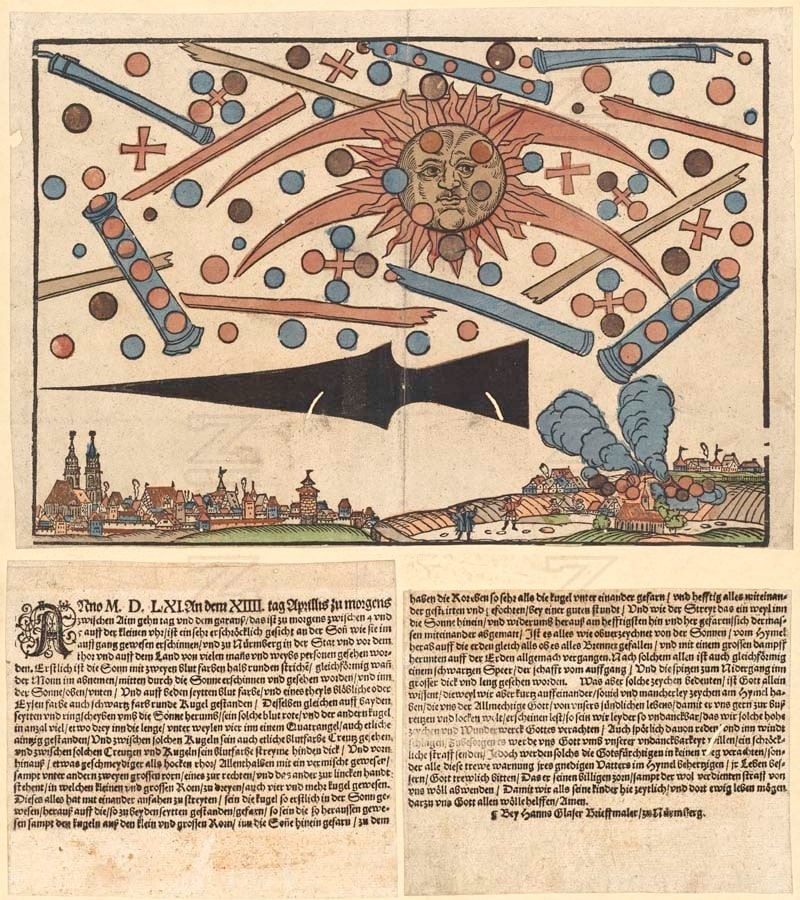
Broadsheet: the celestial appearance over Nuremberg, 14 April 1561
Printed 1561 · Nuremberg, Holy Roman Empire
At dawn on 14 April 1561, something frightening was seen at the sun over Nuremberg. A printer had it on sale within days.
Printed broadsheet report
Charles Fort, The Book of the Damned
Compiled c. 1905–1919; published 1919 · New York and London
A New York writer spent years copying anomalies out of scientific journals, and published them as a procession of the excluded.
Editorial compilation
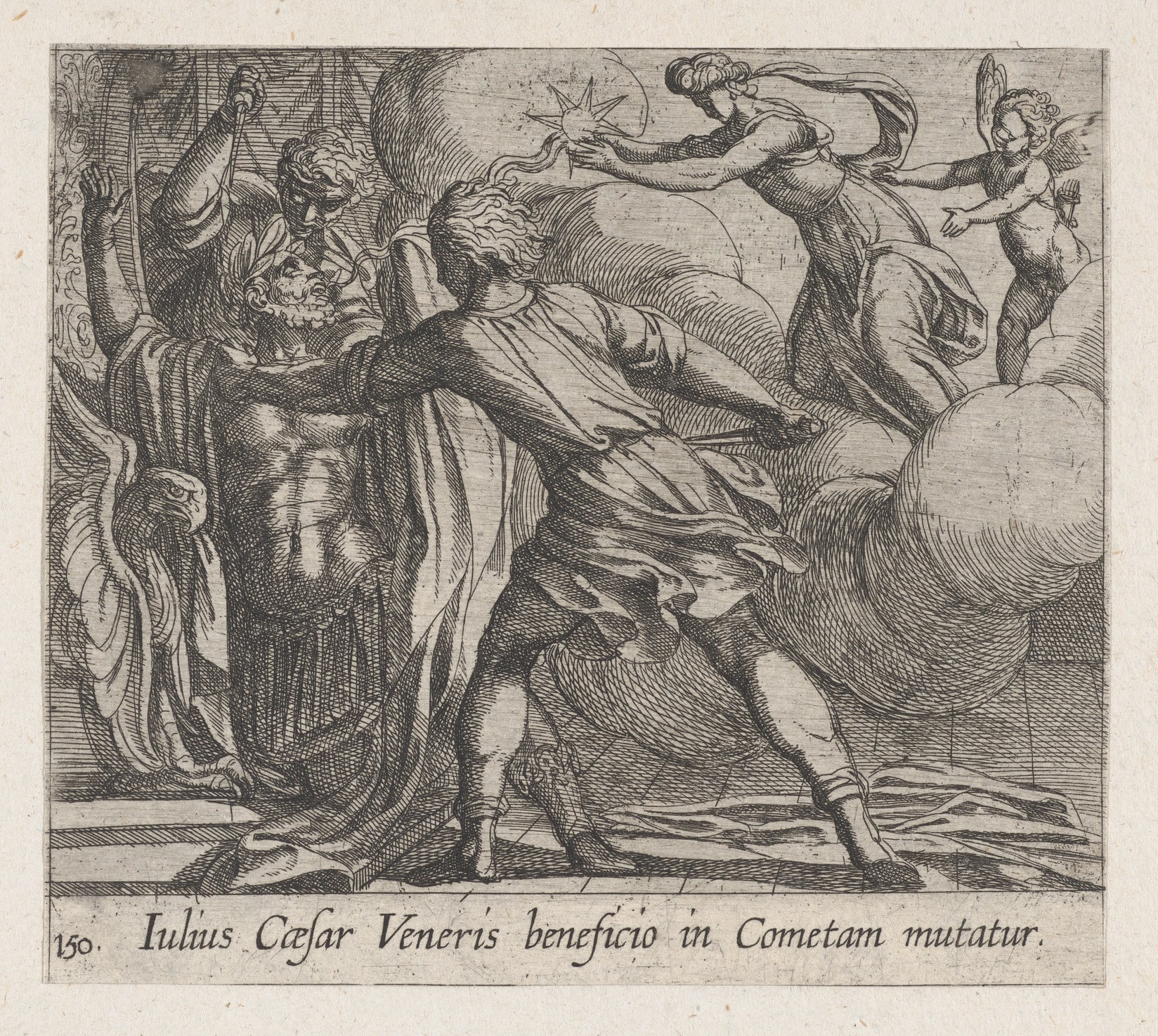
The signs at Caesar's death
15 March – late 44 BCE · Rome and the Mediterranean
Dreams. Failed sacrifices. A darkened Sun. Three suns in the sky. Then, months later, a comet.
Mixed - poetry, history, biography and compilation


